
Restaurant Service Charge vs Tip: Read the Bill Before You Pay
On this page
- Quick answer
- Identify every added charge
- Understand service charge vs voluntary tip
- Check when and where the fee was disclosed
- Ask how the restaurant handles the charge
- Decide whether to add a voluntary tip
- Review tax, percentages, and the final total
- Plan for groups, events, and fixed menus
- Resolve an unclear or incorrect charge
- Use a before-you-pay checklist
Quick answer
Before paying a restaurant bill, look for lines labeled service charge, gratuity, automatic gratuity, hospitality charge, administrative fee, large-party fee, delivery fee, or another mandatory amount. Read the menu and reservation terms, confirm whether the charge is required, and ask the restaurant what it covers. Do not assume that every amount described with the word “service” goes directly to your server.
For federal wage and tax purposes, a compulsory charge is generally treated differently from a voluntary tip. A tip is an amount the customer freely chooses and controls; a mandatory service charge is imposed by the business. State and local rules may add disclosure, distribution, or consumer-protection requirements, so ask the restaurant and check the law that applies where you are dining.

Identify every added charge
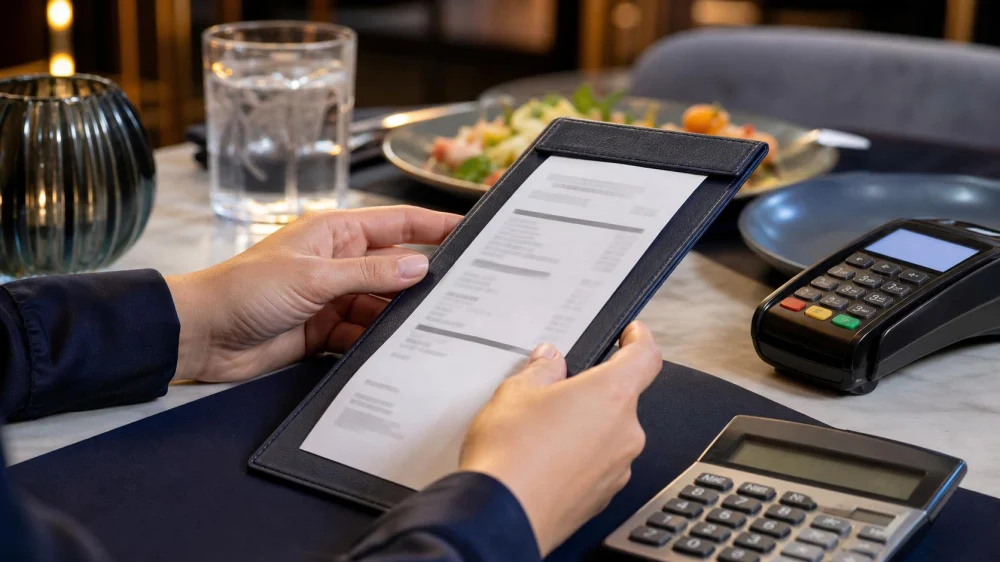
Start with an itemized bill. Compare food and drink prices with the menu, then locate taxes, service charges, gratuities, discounts, deposits, and credits. A percentage may appear near the subtotal, while a flat event or room fee may appear elsewhere. On a payment terminal, scroll through the full bill before selecting a tip option.
Labels are not always consistent. “Auto-gratuity” may be mandatory even though it contains the word gratuity, while a suggested 18%, 20%, or 25% button may still be optional if the customer can choose another amount or zero. Ask a direct question: “Is this charge required, and is the tip screen asking for an additional voluntary amount?”

Understand service charge vs voluntary tip
The U.S. Department of Labor Fact Sheet #15 says a compulsory service charge is not a tip under the Fair Labor Standards Act. The IRS tip reporting guidance likewise distinguishes mandatory service charges from amounts the customer voluntarily decides to pay and determines.
This federal distinction concerns wage and tax treatment; it does not by itself tell a diner exactly who receives a particular restaurant’s charge. The restaurant may distribute some or all of it as wages, use it for broader operating costs, or handle it in another lawful way. A voluntary extra amount can still be a tip even when the bill already contains a service charge.
Check when and where the fee was disclosed
Look for notice on the menu, reservation page, confirmation email, event contract, entrance sign, and bill. The notice should help you understand the percentage or amount, what purchases it applies to, and whether tax is calculated before or after it. For a large party, confirm the threshold because infants, non-diners, or separate checks may still count toward group size.
Before booking a costly meal, ask for the policy in writing. Useful questions include: Is the charge mandatory? Does it apply to beverages, takeout, private rooms, or deposits? Will a separate tip prompt appear? Can a disclosed charge change for a holiday, large party, or special menu? Clear answers prevent a surprise at the end of the meal.
Ask how the restaurant handles the charge
If it matters to your decision, ask a manager how the service charge is used and whether any portion is distributed to the service team. Keep the wording neutral: “Can you explain how this charge is handled?” A server may not control the policy and may not have payroll details, so a manager or written policy can be the better source.
Avoid assuming that the full percentage belongs to one employee or that employees receive none of it. The answer can vary by business, role, event contract, and jurisdiction. If the restaurant says the charge supports wages, benefits, or operations, ask whether an additional tip is customary but remember that a truly voluntary tip remains your choice.
Decide whether to add a voluntary tip
First determine whether the bill already includes a mandatory amount and what the restaurant says it covers. Then decide whether you want to add a separate voluntary tip. You may consider service, local customs, the restaurant’s explanation, and your budget. The presence of a tip line or suggested buttons does not automatically mean another payment is required.
When using a payment terminal, look for “custom” or “no tip” if you do not want to add more. If the interface prevents a zero or custom choice even though the amount is described as optional, ask for assistance before authorizing payment. Do not sign or tap through a total you have not reviewed.
Review tax, percentages, and the final total
Check the base used for each percentage. A service charge might be calculated on food and beverage before tax, but policies vary. A suggested tip might be based on the pre-tax subtotal, the post-tax amount, or a total that already includes a service charge. Calculate from the amount you intend rather than relying on a suggested number.
Confirm that deposits, gift cards, discounts, or promotional credits were applied once and in the correct place. Compare the itemized subtotal, fees, tax, any voluntary tip, and final total. When splitting payment, verify whether the mandatory charge was divided across checks or accidentally repeated on each one.
Plan for groups, events, and fixed menus
Large-party and private-event contracts commonly include fixed service or administrative charges. Before signing, ask for a sample invoice showing food, drinks, room rental, service charge, tax, gratuity, and deposit credits. Confirm the guest-count deadline, cancellation terms, minimum spend, overtime, cake or corkage charges, and whether vendors or children affect the count.
Tell the group before the meal how mandatory charges and voluntary tips will be handled. Decide whether one person will pay, whether the restaurant permits split checks, and how shared items will be divided. For reimbursed business meals, save the contract and itemized receipt because a card slip alone may not explain the fees.
Resolve an unclear or incorrect charge
Raise the question before paying. Point to the exact line and ask for the menu, reservation term, or policy that applies. If the amount was duplicated, calculated on the wrong subtotal, not disclosed as expected, or differs from the contract, request a corrected itemized bill and keep both versions.
Stay factual and speak with a manager if the first explanation is incomplete. Save screenshots of reservation terms, the menu, receipt, and payment confirmation. If a charge remains disputed, follow the restaurant’s written process, then contact the card issuer or the relevant state or local consumer agency when appropriate. Do not initiate a chargeback simply because you later reconsider a clearly disclosed charge.
Use a before-you-pay checklist
Ask five questions: What is the charge called? Is it mandatory? What subtotal is it based on? What does the restaurant say it covers? Is the tip prompt requesting an additional voluntary amount? Then verify the itemized food and drink charges, deposit or discount, tax, service charge, extra tip, and final total.
For ordinary dining, a one-minute bill review is usually enough. For a group or event, obtain the policy and a sample total before booking. The key is not to guess from a label: distinguish required charges from voluntary choices, ask how the specific restaurant handles them, and keep the receipt.






 Shabuway4.0 (334 reviews)
 Izumi Kaiten Sushi3.0 (9 reviews)
 Testarossa Catering Kitchen0.0 (0 reviews)
 Gyros, Burgers & More4.0 (394 reviews)
 Nboucherhomes0.0 (0 reviews)
 JangTu Restaurant4.0 (565 reviews)
 Top Italian Restaurants in Brooklyn: A Local Dining Guide
 Late-Night Dining: Where to Find 24-Hour Breakfast All Year Round
 What Makes Some Dining Options Better When You’re Short on Time
 Discovering the Best Fast-Casual Restaurants Open Late for Quick Bites
 The Rise of “Swicy” Flavors at Restaurants Open Now—What to Try & Where | Restaurant Locator
 Why Restaurant Hours Are Expanding: The New Trend of Late-Night Dining