
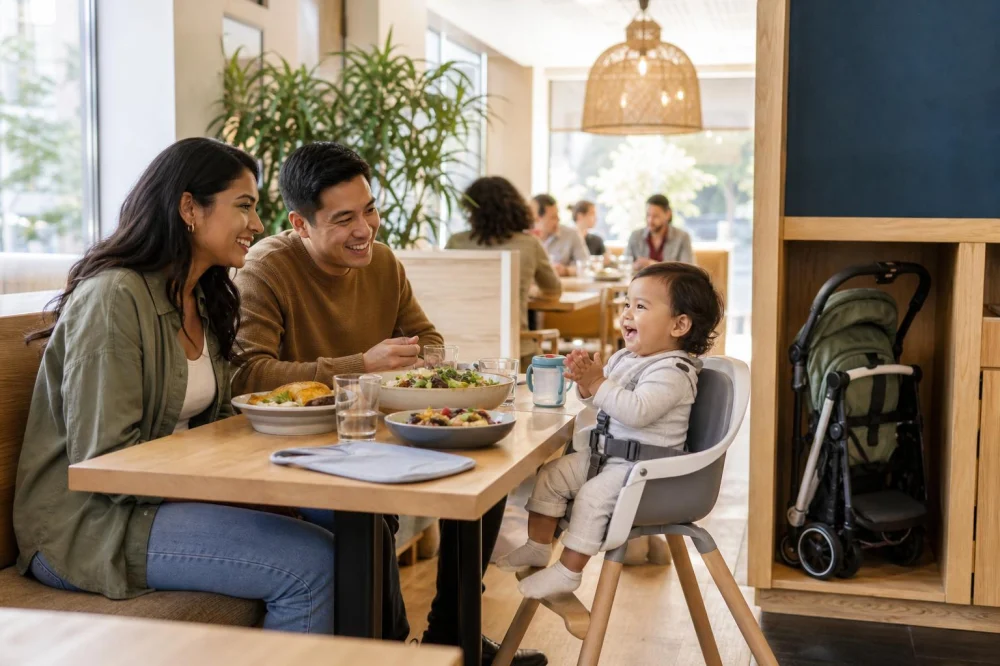
How to Confirm a Restaurant Works for Young Children
In this guide
A restaurant can welcome families and still lack the particular equipment, space, menu, or service pace a young child needs. “Kid-friendly” is too vague to plan around. A brief call with specific questions—high chair, stroller storage, allergy process, changing space, and expected meal length—can reveal whether the visit will work.
Quick answer
Call the exact location and state the child's age, party size, and equipment needs. Ask whether high chairs or boosters are available and reservable, whether a stroller can be parked without blocking an aisle, whether the restroom has a changing station, and how the kitchen handles the child's dietary needs. Choose an earlier or quieter service, request food promptly, and keep hot dishes, knives, cords, glassware, and small choking hazards away from the child.

Ask specific questions before leaving
Restaurant layouts and supplies differ by branch, so use the location's direct number. Instead of asking “Are you family-friendly?” ask what you actually need: “Do you have a high chair with working restraints available at 5:30, and is there space to park a folded stroller?”
Tell the host how many adults, children, infants, high chairs, boosters, wheelchairs, and strollers are in the group. These affect the table footprint and fire-code aisles. An infant does not disappear from the head count merely because they do not order food.
Ask whether every guest must be present before seating and whether equipment can be noted but not guaranteed. Bring a backup plan if the restaurant has only a few high chairs.
Confirm high-chair and booster-seat options
A high chair should be stable, clean, appropriate for the child's developmental stage, and used with its provided restraint according to the manufacturer's design. Check straps, buckles, locking parts, tray, and distance from the table before seating the child. Ask staff for another chair if it wobbles, has a broken strap, or does not lock.
A booster is for a child who can sit upright reliably and fits within the product's limits. Secure it to a suitable chair as designed and use its child restraint. Never place an infant car seat, portable booster, or high chair on top of a regular chair unless the product is specifically designed and approved for that setup.
Do not substitute an upside-down restaurant high chair as an infant-car-seat stand. Keep a car seat on an approved restaurant carrier, a safe floor location out of traffic, or another arrangement specifically allowed by its manufacturer and the restaurant.
Plan where the stroller can go
A stroller can help a sleeping infant but can also block service paths, exits, or access for other guests. Ask whether it can be brought to the table, folded and stored, or must remain elsewhere. Mention a double stroller or large travel system because its footprint is different.
Do not park a stroller in an aisle, doorway, stair landing, or route to an emergency exit. Lock the wheels when stationary and keep bags from making it unstable. Never rely on a server to move a stroller containing a child.
Outdoor patios may have steps, narrow gates, uneven pavers, heaters, traffic exposure, or seasonal closures. Confirm the actual route and conditions if step-free access matters.
Check the menu without assuming a kids' menu
A printed kids' menu does not guarantee that a child will eat the food, and no kids' menu does not mean the restaurant cannot serve a suitable portion. Review the current menu and ask about plainly prepared components, sides, portion sizes, spice, sauces, and how long they take.
For babies and toddlers, consider texture, temperature, salt, added sugar, bones, pits, hard raw pieces, whole grapes, nuts, popcorn, tough meat, and other choking risks. Caregivers should prepare food in a size and texture appropriate to the individual child's development.
Ask whether outside baby food, formula, or a medically required item is permitted. Do not expect the kitchen to heat a bottle or homemade food; food-safety policies may prohibit it.
Discuss food allergies with the restaurant
Notify the restaurant before arrival about a diagnosed food allergy and repeat it to the server. Ask how orders are communicated to the kitchen, whether ingredients can be checked, and whether shared fryers, grills, utensils, or preparation surfaces create cross-contact.
A “kids' item,” “plain” dish, or removal of a visible topping does not prove safety. Sauces, marinades, breading, desserts, garnishes, and cooking oil can contain allergens. If staff cannot confidently answer, choose another item or restaurant.
Carry prescribed emergency medication and follow the child's medical action plan. Restaurant precautions reduce risk but cannot replace readiness to respond.
Ask about restrooms and changing space
Changing stations may be in one restroom, all restrooms, an accessible family room, or nowhere. Ask about availability and location. A portable changing mat and supplies can help, but a dining table or restaurant seat is not a sanitary changing surface.
Check whether the route has stairs, narrow doors, or a heavy door that is difficult with a child. A family or single-user restroom may simplify a caregiver's visit, but availability and naming vary.
Bring diapers, wipes, disposal bags, a change of clothes, and hand-cleaning supplies. Take soiled items to the designated bin and notify staff if a surface needs cleaning.
Choose a realistic time and service style
Match the meal to the child's usual hunger and sleep schedule when possible. An early reservation can reduce waiting and crowding, but ask the restaurant when it is actually calm; brunch or pre-theater periods may be busy even at an early hour.
Counter service, food halls, cafés, and casual restaurants may offer faster ordering, while full-service dining can provide more table support but take longer. Neither format is automatically better. Consider line length, table availability, noise, and whether food can arrive in stages.
Ask for the child's suitable food early and request the check before a crisis develops. If the child becomes overwhelmed, take a brief break outside or end the meal. Flexibility is part of the plan, not a failure.
Set up the table for safety
Before seating the child, move knives, hot plates, candles, glassware, condiment bottles, cords, and breakable decorations out of reach. Keep hot beverages away from the edge and do not pass them over a child. Tablecloths can be pulled, bringing dishes down with them.
Place the high chair where servers can see it and move safely, not at the end of a busy aisle. Keep adult bags under control and remove small items such as sugar-packet tabs, toothpicks, coins, caps, and decorative stones.
An adult should actively supervise. A restraint reduces falls but does not make a child safe to leave alone, climb, stand in the chair, or reach toward service traffic.
Bring a small restaurant kit
- Wipes, bib, and a washable placemat if useful
- Child utensils and a spill-resistant cup permitted by the restaurant
- A quiet, clean activity without loose tiny pieces
- Diapers, changing mat, disposal bags, and spare clothes
- Any medically necessary food, supplies, and prescribed medication
- A light layer for strong air conditioning or outdoor temperature changes
Keep the kit compact so it does not block an aisle. Avoid loud electronic audio; headphones are not always appropriate for very young children, and volume should be safe and supervised.
Frequently asked questions
Can a restaurant reserve a high chair?
Some note the request but cannot guarantee equipment. Ask directly and have a safe backup, such as a manufacturer-approved portable seat if the restaurant permits it.
Does an infant count in the reservation?
Yes, include every person and explain whether the infant needs a high chair, stroller space, or room for a car seat.
Can I bring my own food for a child?
Policies vary, especially for outside prepared food. Ask first and explain medical or infant-feeding needs.
Is patio seating easier with children?
Sometimes, but consider weather, sun, insects, traffic, heaters, uneven surfaces, and whether the stroller route is accessible.
What if my child becomes disruptive?
Respond calmly, meet the child's need, take a break away from other diners, or request food to go. Planning an exit option makes that decision easier.
Match the restaurant to the child and the day
A successful family meal depends less on a vague “kid-friendly” label than on a practical fit. Confirm seating equipment, stroller space, menu and allergy needs, restroom facilities, service pace, and access at the exact location. Arrive with a small kit, arrange the table safely, supervise actively, and keep a flexible exit plan. Those details let adults and children focus on the meal rather than preventable surprises.

 ZENSHI Handcrafted Sushi0.0 (0 reviews)
 Umi Hand Roll Bar3.0 (92 reviews)
 Momo's Place Authentic Soul Food3.0 (7 reviews)
 Wienerschnitzel4.0 (992 reviews)
 Panda Express3.0 (544 reviews)
 Little Caesars Pizza4.0 (514 reviews)
 Late-Night Dining Trends in the U.S.: What’s New and What’s Here to Stay
 The Best Taco Restaurants Open Near Me for Midnight Tacos and Salsa
 Highlighting Woman-Owned Restaurants That Recently Extended Their Hours
 Best Places to Find Late-Night Dim Sum and Asian Street Food
 Best Italian Restaurants Open Late for Midnight Pizza and Pasta Dishes
 Best Restaurants Open Near Me for Sushi Lovers Tonight